Launch pricing: the full kit, 126 illustrated pages, is $27 while we're newLaunch pricing: full kit, 126 pages for $27
The Catering Business cover Selling and Running Events cover Service, Drawn cover

The Whole Catering Business. Explained With Drawings.

Three illustrated guides for running a catering business: what to charge per guest so food, staff and travel are covered, kitchens, permits, deposits and contracts; selling and running events; and service, drawn. One idea a page, each one drawn.

Secure purchase No subscription 7-day guarantee

Here's what the pages look like

Real pages from all three guides. One idea a page, drawn, with the money worked out.

What's included

Three illustrated guides

The Catering Business, Selling and Running Events, and Service, Drawn. 126 pages, one idea each.

One idea, drawn

The idea, the picture, the numbers worked out and the costly mistake. Read it before you quote.

Made for your phone

Phone-sized PDFs to check in the kitchen, in the van or at the venue, yours to keep. Nothing to cancel.

You know how to cook for a crowd. Nobody taught you the money.

Most of the money a caterer loses goes quietly: a price set from the food alone, prep day and the drive nobody priced, small parties at big-party prices, raw weight costed as served weight, and a date held on a handshake. Every one of them has a page, and every page names the mistake.

The money pages: where caterers lose money

Pricing at three times food cost: $27 a guest, when the full cost of the example buffet is $25

Taking a 20-guest party at the buffet price, when the $400 event cost still comes and you lose $175

Pricing only the hours at the party, when prep day and the drive are 20 of the 32 hours

From Book 1 · Per-head price

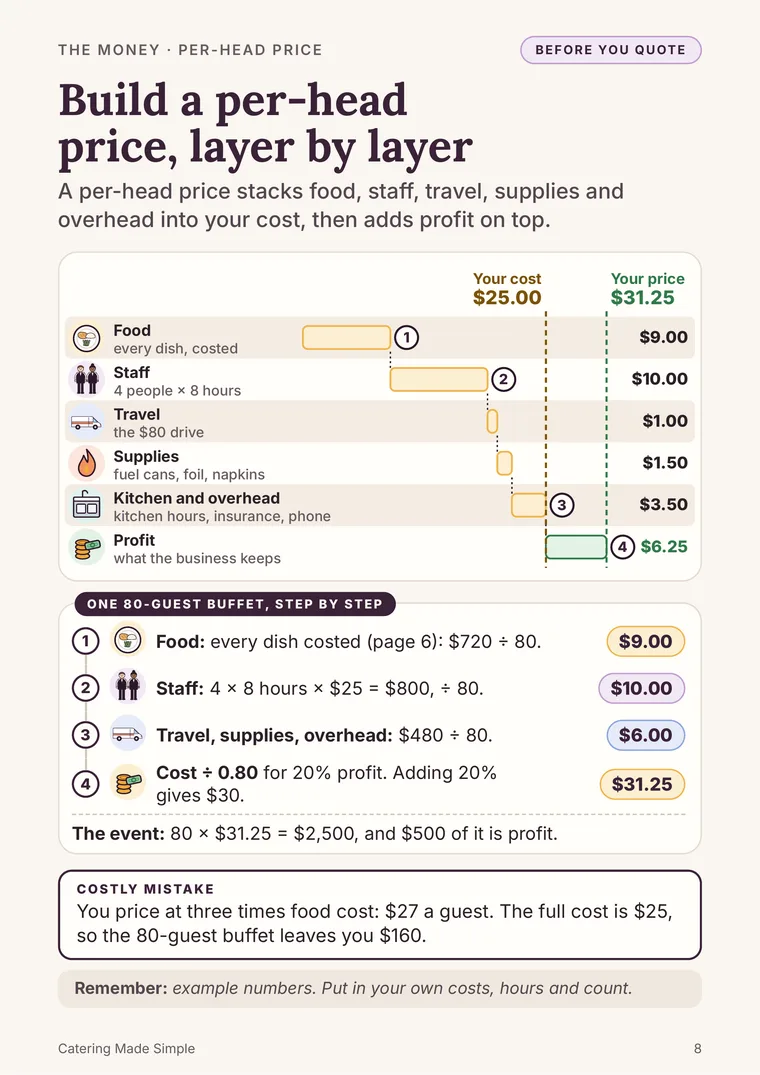
Build a per-head price, layer by layer

Book 1, page 8, Build a per-head price, layer by layer: on the example 80-guest buffet the full cost is $25 a guest and the price $31.25
From Book 1 · page 8
The idea A per-head price stacks food, staff, travel, supplies and overhead into your cost, then adds profit on top.
Costly mistake You price at three times food cost: $27 a guest. The full cost is $25, so the 80-guest buffet leaves you $160.

A drawing is easier to take in between prep and delivery than a paragraph. That's why every page in the kit has one, with the numbers worked out.

Same menu, same kitchen. A very different month.

From this

Learning it the expensive way

  • A group thread at midnight that argues with itself about what to charge a head
  • A price that sounds fair, and no number of your own to check it against
  • A full calendar of events, and a bank account that doesn't show it
To this

The page for this decision

  • One idea, one drawing, read in a minute
  • The numbers worked out on the same page
  • The costly mistake named, so you skip it instead of paying for it

One page, up close

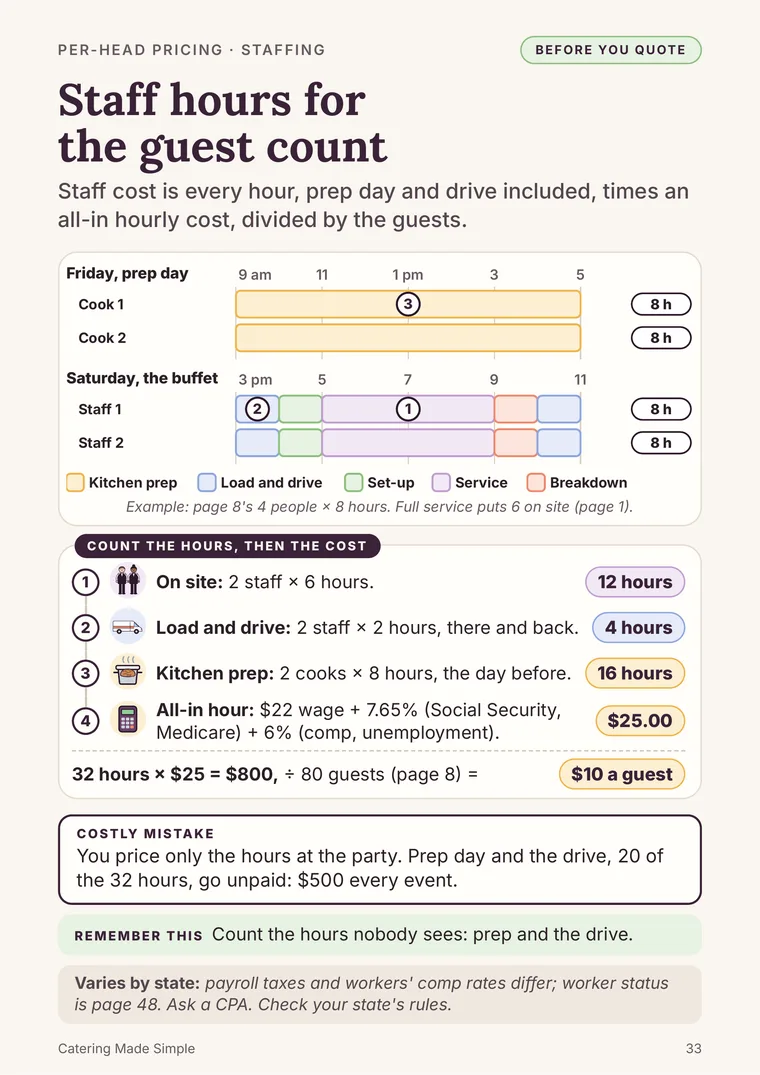
Every page has the same parts, so you always know where to look. Here is Book 1, page 33, Staff hours for the guest count, with its lines quoted from the guide.

Book 1, page 33, Staff hours for the guest count: the whole page
The idea

Staff cost is every hour, prep day and drive included, times an all-in hourly cost, divided by the guests.

Costly mistake

You price only the hours at the party. Prep day and the drive, 20 of the 32 hours, go unpaid: $500 every event.

Remember this

Count the hours nobody sees: prep and the drive.

Quoted word for word from Book 1, page 33. The hours and the $500 are the kit's example figures, labelled as examples. Every page carries these parts plus the drawing, and where a rule changes from state to state or county to county, a note that says so.

The three guides

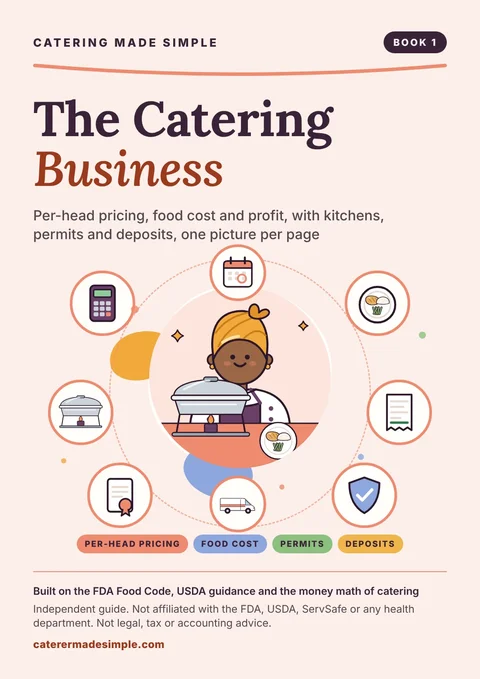
Book 1: The Catering Business

50 teaching pagesEight partsEvery page drawnPer-head pricing and profit

The business, the money, setting up, insurance and contracts, food cost, per-head pricing, getting paid, and profit and taxes, one idea a page. Start with the per-head price.

  • The business and the money: drop-off, buffet or full service, home kitchen or commercial kitchen, the permits most caterers need, insurance, food cost percent, costing one portion, buy weight against serve weight, the per-head price layer by layer, minimums for small events, deposits that hold the date
  • Setting up, insurance and contracts: sole owner, LLC or corporation, a first-year setup checklist, cottage food laws, shared kitchens, the health inspection, food manager and handler certificates, event permits, alcohol, allergen questions, certificates of insurance, liquor liability, the contract, final counts, cancellations, and a guest who says they got sick
  • Food cost and per-head pricing in depth: real invoices, where caterers buy, price rises, portions, waste, menu mix, staff hours, travel, rentals, service charges, good-better-best menus, guest prices, drop-off pricing, and three events priced start to finish
  • Getting paid, profit and taxes: payments and their fees, late payers, sales tax, cash for slow months, profit per event, prime cost, raising prices, staff status, estimated taxes and records
Book 2: Selling and Running Events

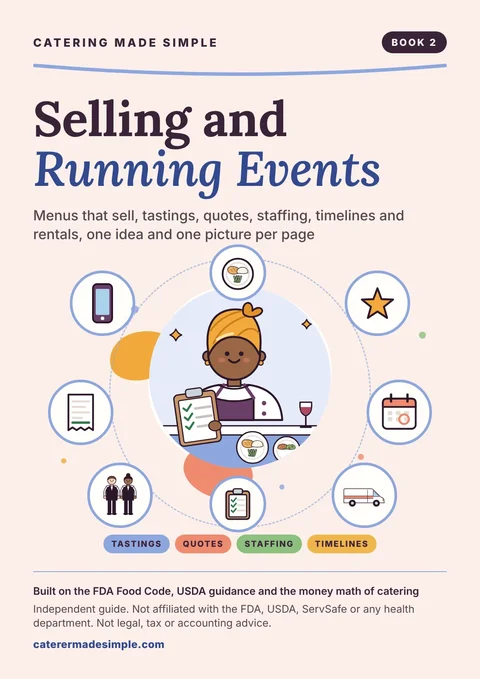
39 teaching pagesSeven partsEvery page drawnInquiry to thank-you

Getting booked and running the day: what to sell, getting found, tastings and quotes, planning, staffing, event day and keeping clients, in the same layout.

  • What to sell and getting found: the events you cater, who books and when, your service area, menus that sell and travel well, a menu page, your Google Business Profile, reviews and photos, posts that book tastings, venue and planner referrals, corporate lunch accounts
  • Tastings and quotes: answering every inquiry fast, the first call, tastings that turn into bookings, a quote the client can read, follow-up without pestering, when a client asks for cheaper, jobs to turn down
  • Planning and staffing: the event sheet, the timeline from booking to cleanup, the venue visit, shopping lists, the prep schedule, rentals, pack lists, how many staff, hiring, training, the briefing, breaks and safety
  • Event day and keeping clients: load and arrive, set up, running the service, Plan B, breakdown, leftovers, the thank-you and review request, repeat corporate clients, the holiday season, from solo caterer to a team

Book 3: Service, Drawn

37 teaching pagesSix partsEvery page drawnBuffet to bar

How the food gets from your kitchen to the guest, drawn: layouts, holding, transport, portions and food safety at the venue, with the FDA Food Code sections named.

  • Buffets and plated service: buffet lines, chafing dishes and fuel, hot holding at 135°F, cold holding at 41°F, utensils and refills, stations, labels, the place setting, the plating line, serving order, family style, passed appetizers, clearing
  • Transport and holding: insulated carriers, packing the van, temperatures on arrival, time as a control under a written plan, cooling, reheating, ice and coolers
  • Prep and portions: how much food per guest, scoops and ladles, hotel pans, a prep schedule for 100 guests, labels and dates, allergens kept apart at prep
  • Food safety at events and drinks: handwashing off site, gloves, probe thermometers, sick staff, sanitizing at the venue, allergen questions at the buffet, drink stations, coffee, cake, bar service and ice

Here's everything you get

Selling and Running Events The Catering Business Service, Drawn

The Catering Made Simple Kit

  • The Catering Business55 PDF pages, 50 teaching pages: per-head pricing, food cost and yield, minimums and deposits, kitchens and permits, insurance, contracts, sales tax and profit per event
    $45
  • Selling and Running Events44 PDF pages, 39 teaching pages: menus that sell, getting found, tastings, quotes, the event sheet, timelines, staffing and event day
    $25
  • Service, Drawn41 PDF pages, 37 teaching pages: buffet and plated layouts, hot and cold holding, transport, prep schedules, portions and food safety at the venue
    $25

Total value: $95

Launch price
$27

One-time payment. No subscription. Keep the files forever.

Yes, I want the kit for $27
Secure purchase No subscription 7-day guarantee
Payments by Stripe

Digital guides (PDF), in English. We email your library link right after purchase, and you can download the files again anytime. Plus sales tax where applicable.

Catering Made Simple is an independent guide for people running a catering business. It explains rules in plain words and is not legal, tax, accounting or food-safety certification advice. It does not promise any business, income or profit result.

Is this kit for you?

A good cook about to take paid events

Friends keep asking you to cook for their parties; the business side is new. Book 1 lays out drop-off, buffet or full service, home kitchen or commercial kitchen, the permits most caterers need and insurance, then how to price per head before your first quote.

Booked every weekend, and the month still doesn't add up

The calendar is full and the account is still thin. Food cost, yield, staff hours, travel, minimums, deposits and profit per event each get a page, worked with the kit's example numbers you can swap your own into.

Ready for bigger events

Weddings, corporate lunches, a crew to hire. Book 2 covers tastings, quotes, the event sheet, staffing and event day, and Book 3 draws buffet and plated service, holding temperatures and a prep schedule for 100 guests.

How this kit is made

No gimmicks. Built on the FDA Food Code, public food safety guidance and state and county pages as labelled examples, drawn clearly, with the source named on the page where it matters.

Built on named sources

The holding, transport, cooling and handwashing pages follow the FDA Food Code (2022) by section; the 2-hour rule is USDA's consumer guidance, and where the two differ the page says so; the tax and staff pages follow IRS publications; the kitchen and permit pages show state and county pages as labelled examples. Every page was checked against its named sources before release.

Honest about your county

Whether you can cook at home, which kitchen you need, food handler cards, event permits and alcohol rules change from state to state and county to county. Those pages teach the shared pattern, label any one place as an example, and end with: check your county health department.

Example numbers, shown working

The money pages work the same example numbers all the way through: an 80-guest buffet with $9 of food, $10 of staff, $25 of full cost and a $31.25 price at a 20% margin, $2,500 for the event, a $400 fixed cost per event and a 25% deposit. You can see where each number comes from and swap in your own. The examples are examples, not prices for your market.

Independent, on purpose

Not affiliated with or endorsed by any health department, the FDA, the USDA, any state or local government agency, any food safety certification or training provider, or any catering, restaurant or hospitality association. We answer to the caterer.

7-day money-back guarantee

Use the kit for 7 days. If it isn't for you, email us and you get 100% of your money back. No fine print, no hassle.

Questions, answered

How do I get it?

Right after purchase we email you a link to your library, where you download all three guides as PDFs. You can come back and download them again anytime.

Is this a one-time payment or a subscription?

One-time payment of $27. No subscription, no recurring charges, and nothing to cancel. All three guides are yours to keep.

Who is it for?

Home-based and small caterers, drop-off or full service, and good cooks about to take their first paid events. It covers pricing, kitchens and permits, contracts, selling and running events, and service. It is not a food safety certification course and does not replace one.

Can I cater from my home kitchen?

It depends on your state and county. Book 1 shows the pattern most follow: cottage food laws usually cover shelf-stable foods made at home, while perishable catering food is usually made in a kitchen the health department permits, such as a shared or commissary kitchen. The pages show labelled examples and end with: check your county health department.

Is it legal, tax or food safety advice?

No. Catering Made Simple is an independent guide for people running a catering business. It explains rules in plain words and is not legal, tax, accounting or food-safety certification advice. It does not promise any business, income or profit result. Your lawyer, accountant and your county health department apply the rules to your business.

Do I need to buy anything else?

No. The kit is complete on its own.

The Per-Head Pricing and Profit Workbook cover

At checkout there is one optional add-on, The Per-Head Pricing and Profit Workbook: your all-in staff hour, overhead, margin and minimum, then three events priced line by line with example numbers (a drop-off lunch, an 80-guest buffet wedding and a plated dinner), and blank sheets for your own quotes. It's $9, unticked, and you can skip it.

Can I use it on my phone? Can I print it?

Both. The pages are portrait and phone-sized, so you can check one in the kitchen or at the venue, and the PDFs print if you want the prep schedule on the wall.

Will it make my catering business profitable?

We don't promise that, and we'd be wary of anyone who does. The guides show you how each piece works and the mistake that costs money, with the numbers worked on the kit's example figures. Which events you take and what you charge is still your call.

What if it isn't for me?

Email us within 7 days of purchase and we'll refund 100% of your money. Details on the refund policy page.

One last thing before you decide

Every event teaches you something about the business side, and the expensive lessons come with a bill. You don't need another midnight group thread or a per-head price someone swears by. You need the page for this decision, with the money worked out and the mistake named. Built for caterers who want every event to pay them back.

Get instant access
Access confirmed ·
Full kit$27
Get instant access
The full kit · $273 illustrated guides · 126 pagesGet instant access